
Free Google AI courses provide a direct pathway to mastering machine learning, neural networks and generative technologies from industry pioneers. Hosted on the official Google Cloud Skills Boost learning portal, these self-paced modules combine foundational theory with hands-on cloud labs.
Whether you are a student exploring data science or an experienced software developer transitioning into cloud engineering, earning verified credentials helps validate your expertise. Each completed module awards an official digital skill badge that you can embed on your LinkedIn profile, resume or digital portfolio. Below is a comprehensive guide to the top complimentary AI training programs available from Google, complete with syllabus highlights, career benefits and direct enrollment links.
Why Choose Free Google AI Certification Courses?
Before diving into individual course modules, it helps to understand what makes Google’s training ecosystem uniquely valuable for career growth:
- Zero Financial Barrier: Every introductory course and learning path highlighted in this guide is completely free to access, removing financial obstacles to high-level tech education.
- Practical Cloud Integration: Rather than relying purely on abstract theory, lessons demonstrate how concepts operate inside enterprise tools like Google Cloud and Vertex AI.
- Microlearning Structure: Most modules take less than an hour to finish, allowing busy professionals to upskill during lunch breaks or evening study sessions.
- Verifiable Digital Badges: Completing quizzes and labs unlocks shareable Google Cloud skill badges that signal verified competence to hiring managers and recruiters.
Top 9 Free Google AI Courses and Learning Paths
1. Introduction to Generative AI
Artificial intelligence has evolved far beyond simple predictive analytics and rule-based automation. The Introduction to Generative AI microlearning module serves as an accessible starting point for anyone curious about how modern systems produce original text, audio, code and visual media.
During this concise training session, you will examine the core mechanics that separate generative models from traditional machine learning algorithms. Traditional systems typically classify data or forecast numerical trends based on historical patterns, whereas generative architectures synthesize brand-new outputs from learned distributions. The curriculum also introduces Google’s suite of developer tools designed to help creators prototype and launch their own generative applications.
Key Takeaways and Career Value:
- Clear breakdown of generative AI concepts, model types and real-world business applications.
- Overview of Google ecosystems used to build next-generation software solutions.
- Official completion badge displayed on your public learner profile to demonstrate foundational AI literacy.
2. Introduction to Large Language Models
Natural language processing has experienced a massive breakthrough thanks to transformer-based architectures. Enrolling in the Introduction to Large Language Models course gives you a structured look at how massive text-trained networks comprehend, summarize and generate human-like language.
This module demystifies the architecture behind modern conversational agents and enterprise search tools. You will explore practical industry use cases ranging from automated customer support to complex document synthesis. A standout portion of the lesson focuses on prompt tuning, showing you how careful input design and parameter adjustments dramatically improve model accuracy for specialized domain tasks without retraining the entire network from scratch.
Key Takeaways and Career Value:
- Foundational understanding of how large language models process tokens and predict context.
- Practical techniques for optimizing model responses through strategic prompt engineering.
- Shareable digital credential validating your readiness to work with enterprise language tools.
3. Introduction to Responsible AI
Deploying powerful algorithms without ethical guardrails introduces serious risks related to bias, data privacy and algorithmic accountability. The Introduction to Responsible AI course addresses the human and societal dimensions of machine learning development.
Learners examine why ethical governance is essential throughout the entire software lifecycle, from dataset curation to production monitoring. The syllabus walks through how Google operationalizes ethical frameworks across its global products and services. Specifically, you will study Google’s seven foundational AI principles, which prioritize social benefit, fairness, safety, accountability and user privacy while actively avoiding the creation or reinforcement of unfair bias.
Key Takeaways and Career Value:
- Actionable framework for identifying and mitigating algorithmic bias in real-world datasets.
- Deep dive into Google’s seven core principles governing ethical technology deployment.
- Recognized skill badge proving to employers that you prioritize safe, transparent and compliant AI engineering.
4. Introduction to Image Generation
Visual synthesis has moved rapidly from experimental research labs into mainstream creative and commercial workflows. Through the Introduction to Image Generation course, you will uncover the mathematical and physical principles powering modern visual AI engines.
The curriculum centers on diffusion models, an innovative class of machine learning algorithms inspired by non-equilibrium thermodynamics. You will learn how these models gradually add noise to training images and then learn to reverse the process to construct crisp, photorealistic visuals from text descriptions. Beyond conceptual theory, the training illustrates how to train, fine-tune and deploy diffusion architectures on Google Cloud’s enterprise infrastructure.
Key Takeaways and Career Value:
- Conceptual mastery of forward and reverse diffusion processes in computer vision.
- Practical guidance on deploying visual generation pipelines within Vertex AI.
- Digital credential highlighting specialized competence in cutting-edge media synthesis.
5. Encoder-Decoder Architecture
Sequence-to-sequence modeling forms the backbone of machine translation, speech recognition and automated text summarization. The Encoder-Decoder Architecture course provides a technical walkthrough of how neural networks ingest variable-length input sequences and transform them into coherent target outputs.
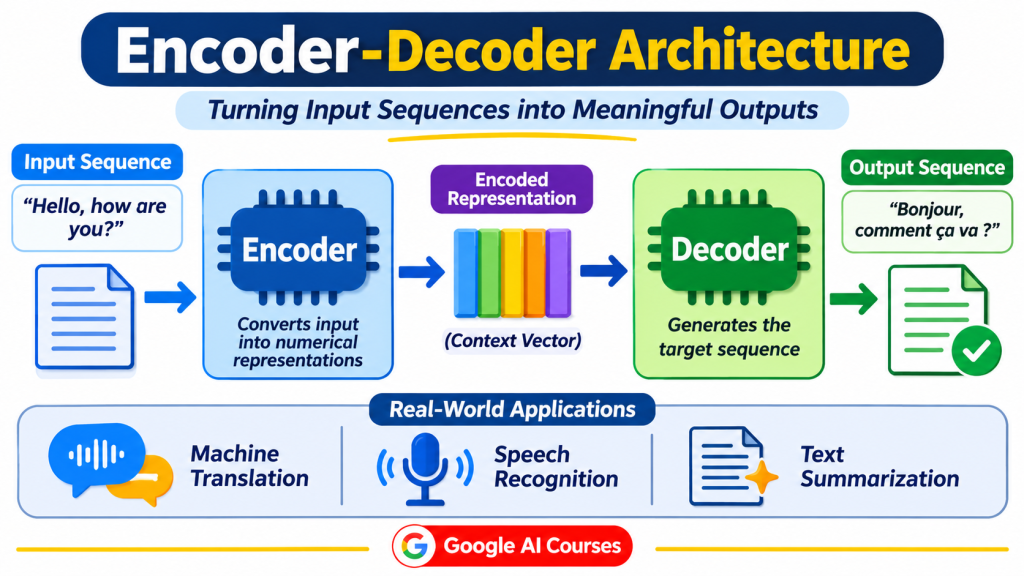
You will study the distinct roles of the encoder network, which compresses input data into a dense contextual representation, and the decoder network, which unpacks that representation step by step. To reinforce the theory, the course includes a guided coding lab where you construct a working encoder-decoder model from the ground up using TensorFlow, applying your code to generate original poetry.
Key Takeaways and Career Value:
- Architectural understanding of sequence-to-sequence neural networks and latent representations.
- Hands-on Python coding experience building and training a generative model in TensorFlow.
- Verified badge demonstrating practical deep learning implementation skills.
6. Attention Mechanism
Before modern transformers existed, recurrent neural networks struggled to retain context across long passages of text. Taking the Attention Mechanism course reveals the breakthrough innovation that solved this bottleneck and paved the way for today’s most capable AI systems.
Completed in roughly 45 minutes, this focused technical lesson explains how attention layers allow neural networks to dynamically weigh the importance of different words or data points within an input sequence. You will see how selective focus dramatically boosts accuracy in complex tasks like cross-lingual translation, abstractive summarization and automated question answering.
Key Takeaways and Career Value:
- Clear grasp of self-attention mathematics and how models prioritize contextual clues.
- Insight into why attention layers outperform legacy sequential processing techniques.
- Fast, high-impact credential showcasing familiarity with core transformer building blocks.
7. Create Image Captioning Models
Bridging the gap between computer vision and natural language processing enables machines to interpret and describe the visual world. The Create Image Captioning Models course teaches you how to combine convolutional visual encoders with sequential text decoders to build multimodal systems.
Throughout the lessons, you will examine how visual feature extraction pairs with language generation layers to produce accurate, human-readable descriptions of photographs. The training covers end-to-end model architecture, training workflows and quantitative evaluation metrics used to measure caption quality in production environments.
Key Takeaways and Career Value:
- Practical blueprint for designing multimodal deep learning architectures.
- Step-by-step understanding of training pipelines and output evaluation strategies.
- Digital badge validating hands-on experience in applied computer vision and language modeling.
8. Introduction to Vertex AI Studio
Moving an AI concept from an experimental notebook to a reliable business application requires robust cloud tooling. The Introduction to Vertex AI Studio course delivers comprehensive training on Google Cloud’s unified platform for prototyping, customizing and scaling generative solutions.
Designed for developers, data scientists, cloud architects and technical product managers, this program guides you through the complete prompt-to-product lifecycle. Through an industry-aligned business scenario and interactive cloud labs, you will practice advanced prompt design, explore model tuning options and work directly with multimodal Gemini capabilities to solve operational challenges.
Key Takeaways and Career Value:
- End-to-end proficiency in prototyping and deploying enterprise AI workflows on Google Cloud.
- Practical experience configuring multimodal Gemini models and refining prompt performance.
- High-value Google Cloud skill badge that strengthens resumes for cloud engineering and AI developer roles.
9. Generative AI Fundamentals Learning Path
If you prefer a structured bundle rather than selecting standalone lessons one by one, the Generative AI Fundamentals learning path packages core introductory modules into a cohesive curriculum. This curated track explores how deep learning frameworks—including Generative Adversarial Networks (GANs), Variational Autoencoders (VAEs) and transformer-based language models—learn structural patterns from massive datasets to create original text, imagery, audio and software code.
Completing the sequence provides a holistic view of modern generative architectures while awarding multiple skill badges along the way. It serves as an ideal foundation before advancing into specialized machine learning engineering or cloud architecture tracks.
Key Takeaways and Career Value:
- Structured progression covering foundational generative paradigms from GANs to modern LLMs.
- Clear conceptual distinction between discriminative prediction and creative synthesis.
- Multiple stackable credentials that demonstrate sustained commitment to continuous learning.
Comparison of Free Google AI Courses
| Course Name | Primary Focus Area | Key Technical Concepts | Credential Earned |
|---|---|---|---|
| Introduction to Generative AI | Core GenAI Concepts | Generative vs. traditional ML, Google AI ecosystem | Digital Skill Badge |
| Introduction to Large Language Models | Natural Language Processing | LLM architecture, enterprise use cases, prompt tuning | Digital Skill Badge |
| Introduction to Responsible AI | AI Ethics and Governance | Bias mitigation, fairness, Google’s 7 AI principles | Digital Skill Badge |
| Introduction to Image Generation | Visual Synthesis | Diffusion models, thermodynamics inspiration, Vertex AI | Digital Skill Badge |
| Encoder-Decoder Architecture | Sequence Modeling | Sequence-to-sequence pipelines, TensorFlow coding lab | Digital Skill Badge |
| Attention Mechanism | Neural Network Optimization | Selective sequence focus, translation, summarization | Digital Skill Badge |
| Create Image Captioning Models | Multimodal Deep Learning | Visual encoders, text decoders, model evaluation | Digital Skill Badge |
| Introduction to Vertex AI Studio | Cloud AI Deployment | Prompt-to-product lifecycle, Gemini multimodal labs | Google Cloud Skill Badge |
| Generative AI Fundamentals | Comprehensive Foundation | GANs, VAEs, LLMs, cross-domain content generation | Multi-Badge Learning Path |
How to Enroll
Getting started with Google’s free training library takes only a few minutes, yet following a strategic study plan will help you extract maximum career value from every module:
- Create a Free Learner Account: Visit the Google Cloud Skills Boost portal and sign in using a standard Google account. Ensure your profile visibility is set to public so recruiters can verify your earned credentials.
- Follow a Logical Sequence: Start with Introduction to Generative AI, Introduction to Large Language Models and Introduction to Responsible AI to build conceptual fluency before tackling technical architectures like Attention Mechanism or Encoder-Decoder Architecture.
- Complete Hands-On Labs Actively: Whenever a course includes a TensorFlow walkthrough or Vertex AI Studio lab, modify parameters and test custom prompts rather than merely copying instructions. Practical experimentation builds lasting intuition.
- Showcase Badges Strategically: Add completed skill badges to the Licenses & Certifications section of your LinkedIn profile, linking directly to your public Google Cloud profile URL for instant verification.
Frequently Asked Questions
Are Google AI courses completely free?
Yes. All nine introductory courses and foundational learning paths listed in this guide are free to enroll in and complete, including access to their interactive quizzes, guided labs and digital completion badges.
Do Google AI courses provide official certificates?
Upon passing the module assessments and labs, Google awards verified Google Cloud Skill Badges. While distinct from proctored paid certification exams, these official digital credentials live on your public learner profile and can be shared on resumes, portfolios and professional networks.
Do I need prior coding experience to start?
No prior programming background is required for conceptual courses such as Introduction to Generative AI, Introduction to Large Language Models or Introduction to Responsible AI. Basic familiarity with Python is helpful when working through technical labs like Encoder-Decoder Architecture.
