

Pursuing an advanced degree in software engineering and artificial intelligence in Europe is a transformative step for international scholars. The Erasmus Mundus EDISS Scholarship 2027 offers a premier pathway for eligible candidates worldwide to gain top-tier academic training while receiving comprehensive financial support.
This guide details everything required to build a competitive application for the Master’s in Engineering of Data-intensive Intelligent Software Systems (EDISS), covering eligibility parameters, financial allowances, host institution structures, document specifications, and step-by-step portal instructions.
Program Overview and Core Details
The EDISS Master’s degree is an elite two-year Joint Master’s initiative funded under the European Union Erasmus+ Program. It addresses the growing global demand for software engineers who possess deep expertise in machine learning, big data architectures, and automated intelligent systems.
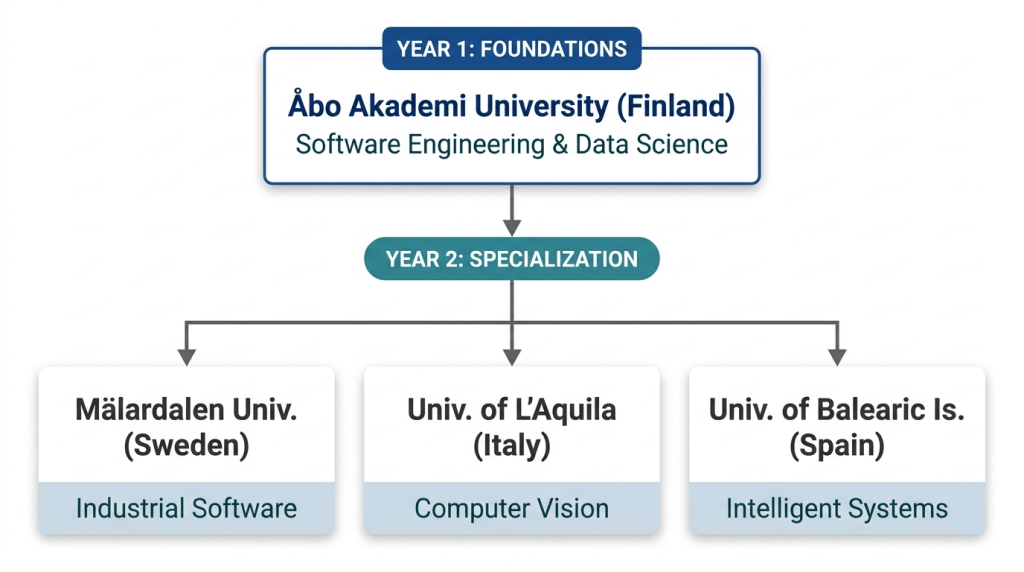
The program combines rigorous theoretical computer science with hands-on system building across multiple European university campuses. Students spend their first year at Åbo Akademi University in Finland, followed by specialization tracks in Year 2 at partner institutions across Sweden, Italy, or Spain.
EDISS 2027 Intake Fact Sheet
| Program Attribute | Official Specifications |
| Degree Name | Master’s in Engineering of Data-intensive Intelligent Software Systems (EDISS) |
| Funding Level | Fully Funded via Erasmus Mundus Joint Master (EMJM) Grants |
| Lead Institution | Åbo Akademi University (Turku, Finland) |
| Consortium Partners | Mälardalen University (Sweden), University of L’Aquila (Italy), University of the Balearic Islands (Spain) |
| Duration | 2 Years (4 Semesters / 120 ECTS Credits) |
| Target Audience | Open to all international applicants regardless of citizenship |
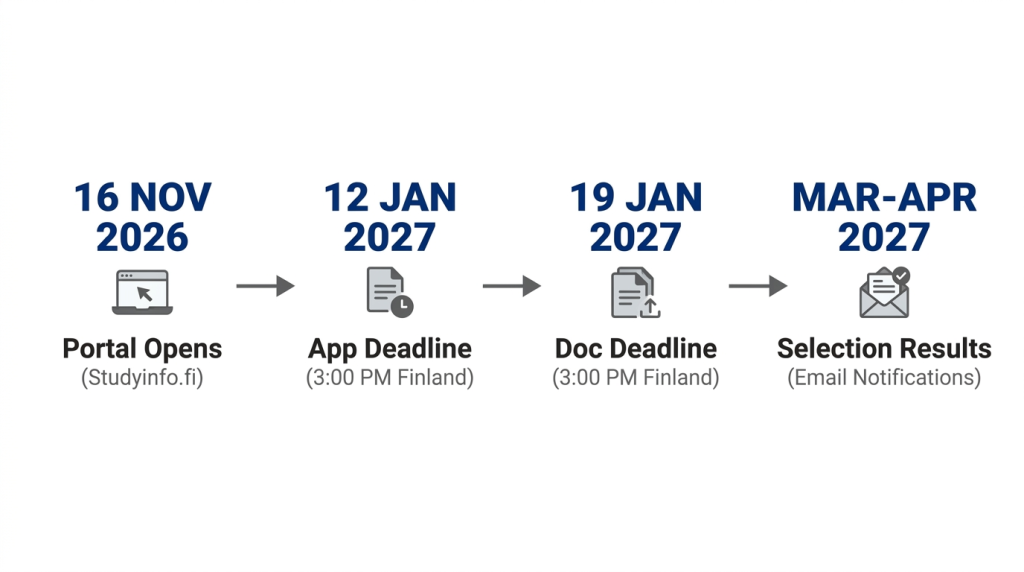
| Application Window | Opens 16 November 2026 – Closes 12 January 2027 (3:00 PM Helsinki Time) |
| Document Upload Deadline | 19 January 2027 (3:00 PM Helsinki Time) |
Detailed Financial Benefits and Scholarship Categories
Financial assistance within the EDISS consortium varies depending on evaluation scores and candidate selection categories. The Erasmus Mundus Scholarship provides the most extensive support package.
1. Erasmus Mundus Scholarship (Full Grant)
Selected recipients of the flagship Erasmus Mundus award receive complete financial backing over the 24-month study period:
- Participation Fee Waiver: Complete coverage of tuition and administrative fees valued at €9,000 per academic year (€18,000 total).
- Monthly Living Stipend: A tax-free allowance of €1,400 per month paid directly to the student for up to 24 consecutive months (totaling €33,600).
- Comprehensive Insurance: Full health, accident, and emergency travel insurance coverage complying with Erasmus Mundus standards.
- Academic Events: Complete funding for mandatory winter schools, workshops, and consortium symposiums.
The combined monetary value of the flagship Erasmus Mundus package reaches €51,600 over two years. Note that the €18,000 fee waiver is credited directly toward tuition costs rather than disbursed as cash. Students utilize their monthly living allowance to manage personal accommodation, flight arrangements, visa procedures, and everyday living costs.
2. Alternative Consortium Funding Packages
Applicants who do not secure the main Erasmus Mundus award remain eligible for secondary consortium awards or tuition reductions based on overall ranking:
| Funding Tier | Tuition Waiver | Monthly Living Allowance | Additional Benefits |
| Erasmus Mundus Grant | 100% Covered (€9,000/year value) | €1,400 per month (24 months) | Health Insurance + Winter School Covered |
| EDISS Consortium Award | 100% Covered (€9,000/year value) | €800/month (Year 1) & €310/month (Year 2) | Full University Student Services Access |
| Tuition Fee Waiver | 100% Covered (€9,000/year value) | No Monthly Stipend Provided | Student Health Services Access |
| Self-Funded Seat | Paid by Student (€9,000/year) | Self-Funded | Standard Campus Services |
Academic Focus and Curriculum Architecture
The EDISS curriculum bridges traditional software engineering and modern data science techniques. Rather than treating software engineering and artificial intelligence as isolated domains, EDISS trains developers to design data pipelines, deploy scalable models, and maintain intelligent software infrastructure.
Specialization Tracks (Year 2 Options)
During their first year at Åbo Akademi University, all students establish advanced competencies in software architecture, cloud computing, machine learning, and data engineering. For the second year, students transition to a partner institution based on their chosen specialization:
- Industrial Software Engineering (Mälardalen University, Sweden): Focuses on large-scale enterprise systems, real-time software architectures, automated testing, and software quality assurance for industrial applications.
- Computer Vision and Intelligent Systems (University of L’Aquila, Italy): Emphasizes image processing, visual machine learning algorithms, pattern recognition, and autonomous robotics architectures.
- Intelligent Systems and Data Analytics (University of the Balearic Islands, Spain): Concentrates on complex networks, optimization algorithms, data mining, and smart decision-support systems.
Upon successful completion, graduates earn a joint or double Master of Science degree issued by the participating consortium institutions.
Academic Eligibility Criteria
Admission into the EDISS program requires strong technical qualifications. Selection committees evaluate academic records, mathematical foundations, and programming experience.
Mandatory Academic Prerequisites
- Higher Education Degree: Applicants must hold an undergraduate degree (Bachelor of Science, Bachelor of Engineering, or equivalent) comprising at least 180 ECTS credits from a recognized university.
- Core Subject Background: Degrees must be in Computer Science, Software Engineering, Computer Engineering, Information Technology, or closely related quantitative disciplines.
- Prerequisite Coursework: Transcripts must show documented coursework in core computer science areas, including:
- Object-oriented programming and software design principles
- Data structures and algorithm design
- Database systems and data management
- Computer architecture or operating systems
- Mathematics (Linear Algebra, Calculus, Discrete Math, and Probability/Statistics)
The admissions committee explicitly states that professional work experience cannot substitute for missing university-level academic prerequisites.
Final-Year Bachelor’s Applicants
Students currently completing the final year of their undergraduate studies may apply for the 2027 intake. If selected, they receive conditional admission. Final-year applicants must upload an official statement from their university verifying their current enrollment status and expected graduation date before the document deadline.
Language Proficiency Requirements
Instruction across all consortium universities is conducted entirely in English. Candidates must demonstrate high proficiency through standardized examinations unless they qualify for a direct exemption.
Accepted Standardized English Tests
| Examination Type | Overall Score Requirement | Minimum Band / Component Requirement |
| IELTS Academic | Overall Band 6.5 | No individual band below 6.0 |
| TOEFL iBT | Minimum Overall Score 93 | Minimum score of 20 in each section |
The EDISS consortium maintains strict test policies:
- Test certificates remain valid for two years from the test date.
- Online home-based tests (such as IELTS Online or TOEFL iBT Home Edition) are strictly not accepted. Candidates must take tests at accredited test centers.
- Test scores must be verifiable online or sent directly to Åbo Akademi University via the testing agency using official institutional codes.
Exemption Criteria
Exemptions from submitting standardized language test results apply only to candidates who have completed an entire undergraduate degree taught in English at an accredited university within the following territories:
- Australia
- Canada (except Quebec)
- Ireland
- New Zealand
- United Kingdom
- United States of America
- EU/EEA Member Countries (provided the degree transcript or diploma supplement explicitly confirms English as the sole language of instruction)
Graduating from an English-medium institution outside these listed regions does not grant an automatic exemption. Candidates educated outside these regions must submit official IELTS or TOEFL results.
Application Documentation Checklist
Preparing precise documentation is critical. Incomplete submissions or missing templates lead to disqualification. All non-English documents must be accompanied by certified, legal translations.
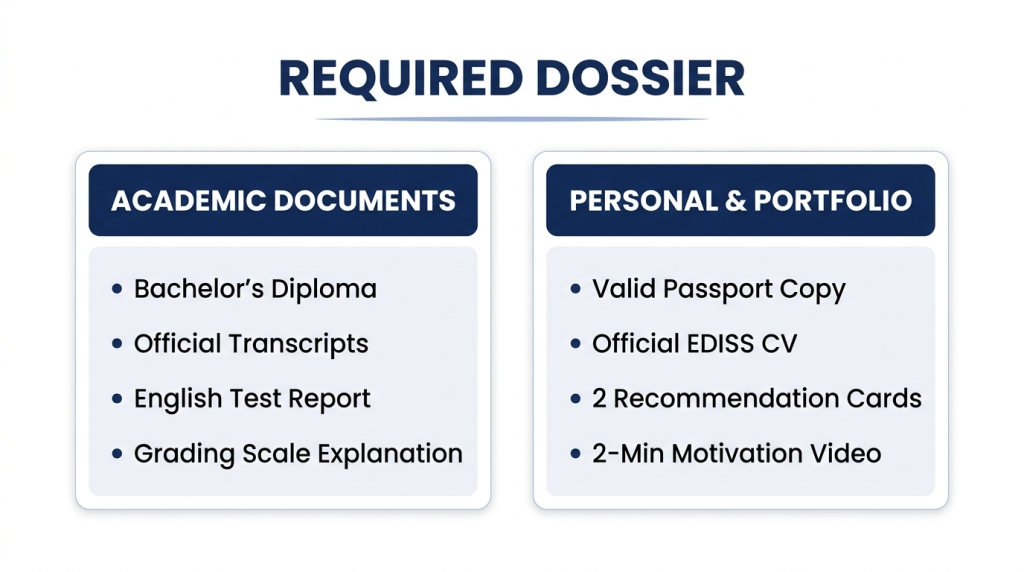
- Bachelor’s Degree Certificate: Official copy of your diploma or an official certificate of expected graduation issued by your university registrar.
- Academic Transcripts: Complete academic records listing all completed courses, earned credits, and achieved grades across every undergraduate semester. Include an official explanation of your university’s grading scale.
- English Proficiency Test Report: Valid IELTS Academic or TOEFL iBT score report meeting minimum sub-score criteria.
- Copy of Passport: Clear scan of the identification page of your valid passport showing personal details, nationality, and expiry date.
- Curriculum Vitae (CV): Structured resume created strictly using the downloadable official EDISS CV template. Non-standard formats may result in point deductions during evaluation.
- Two Academic Recommendation Letters: Formal recommendation letters from university professors or academic supervisors familiar with your technical coursework and research capabilities.
- Motivation Video (Approx. 2 Minutes): A short video recording hosted on an accessible platform (such as YouTube or Vimeo) or uploaded directly. The video must cover three points:
- Your personal motivation for applying to the EDISS program
- Your specific academic and research interests in intelligent software systems
- How your academic background prepares you for high-level study in Europe
- Supplementary Certificates (Optional): Documentation of relevant publications, professional certifications, hackathon awards, or verified software project portfolios.
Document scans must be clear, high-resolution color PDF files. Files must not be password-protected or encrypted.
Step-by-Step Application Guide
Submitting an application for the EDISS Master’s program requires careful timing because the application portal operates on fixed deadlines without extensions.
Phase 1: Preparation (Before 16 November 2026)
- Visit the official portal on the EDISS Admission Website to review updated Intake 7 application guidelines.
- Schedule your IELTS Academic or TOEFL iBT test early to ensure score reports arrive before the application window closes.
- Contact academic referees to request recommendation letters on official institutional letterhead.
- Download the mandatory EDISS CV template and format your academic and technical background accordingly.
- Record and edit your two-minute motivation video, verifying that the link permissions are set to public or unlisted.
Phase 2: Online Submission (16 November 2026 – 12 January 2027)
- Create an applicant profile on the national Finnish portal at Studyinfo.fi once the application window opens.
- Fill out the online application form accurately. Important: The Studyinfo portal does not allow saving incomplete online forms as drafts. Gather all your data, personal information, and links before starting the form session.
- Select your preferred second-year specialization track based on your long-term career focus.
- Complete the submission process before the deadline on 12 January 2027 at 3:00 PM Helsinki Time.
Phase 3: Attachment Finalization (Deadline: 19 January 2027)
- If you need to update or re-upload clear PDF scans of your transcripts, degree statements, or language test scores, use your personal application link provided in your submission confirmation email.
- Ensure all supplementary files are uploaded before 19 January 2027 at 3:00 PM Helsinki Time. Submissions missing required attachments after this date are rejected.
Evaluation Process and Candidate Selection
Applications undergo a two-phase selection procedure conducted by the EDISS Academic Board:
1. Technical Prerequisites Review
The admissions team verifies degree authenticity, checks credit requirements (minimum 180 ECTS equivalent), evaluates mathematical background, and verifies English language test validity. Applications failing basic eligibility criteria are eliminated immediately.
2. Academic Merit Scoring
Eligible candidates are scored out of 100 points based on four primary criteria:
- Academic Background and Performance (Up to 40 Points): Evaluates overall Grade Point Average (GPA), prestige of the degree-granting institution, and performance in computer science coursework.
- Programming Skills and Project Work (Up to 25 Points): Assesses hands-on experience in software engineering, database management, cloud technologies, machine learning projects, and relevant software repositories (such as GitHub portfolios).
- Motivation and Scientific Alignment (Up to 20 Points): Evaluates the quality, clarity, and articulation of academic goals within the submitted two-minute motivation video and CV context.
- Recommendation Letters and Soft Skills (Up to 15 Points): Evaluates academic potential, analytical reasoning, communication skills, and adaptability as described by academic referees.
Highest-ranked applicants are recommended for the Erasmus Mundus Full Grants, while qualified runner-up candidates receive secondary EDISS consortium awards or tuition fee waivers. Formal admission notifications and award letters are emailed to applicants between March and April 2027.
Cost of Living and Logistics for International Students
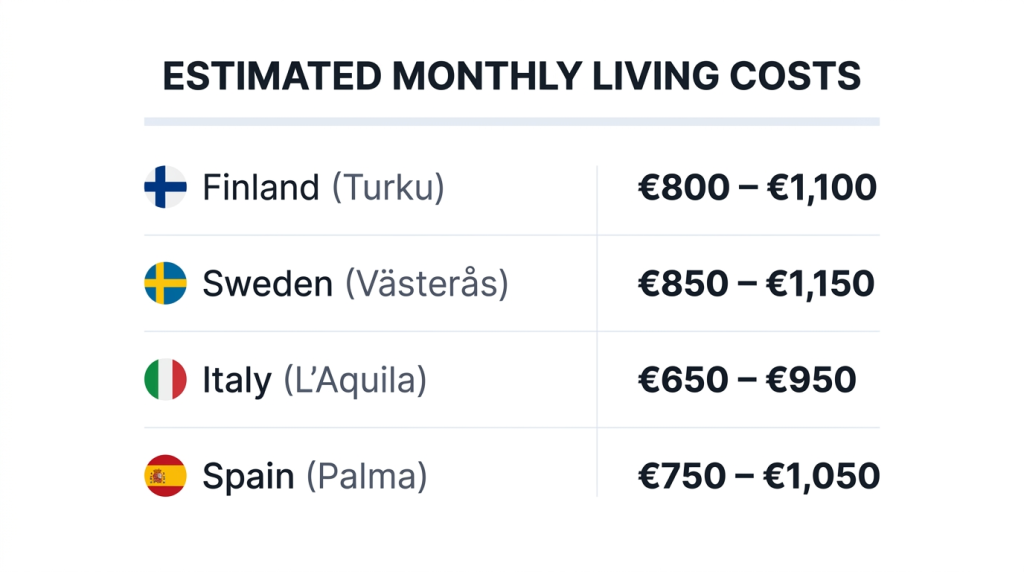
While the Erasmus Mundus scholarship offers €1,400 per month, planning personal budgets remains essential. Living costs vary across consortium study locations:
Breakdown of Typical Student Expenses
- Accommodation: Student housing apartments range from €300 to €550 per month, depending on whether rooming is shared or private. Universities offer subsidized housing options through organizations like TYS in Turku.
- Food and Groceries: Monthly food costs average €250 to €350. Student cafeterias in Finland and Sweden offer subsidized meals for enrolled Master’s students at discounted rates.
- Health Insurance and Residence Permits: Award holders receive fully compliant health insurance. However, students must budget for initial visa application fees, residence permit processing costs, and travel arrangements before arriving in Europe.
Key Tips to Make Your Application Stand Out
Due to high application volume across South Asia, Africa, Latin America, and Europe, competition for Erasmus Mundus scholarships is intense. Follow these strategic steps to maximize your selection chances:
- Tailor Your CV to the Official Template: Avoid submitting standardized LinkedIn or Europass resumes. Use the required EDISS CV format, emphasizing your software architecture, algorithm design, and data engineering projects.
- Highlight Quantifiable Project Outcomes: When detailing past software projects, explain the underlying tech stack, data scale, and machine learning performance metrics achieved.
- Refine Your Motivation Video: Ensure high-quality audio recording and natural lighting. Address the prompt directly without reading from a script. Focus on why the combination of software engineering and intelligent data systems aligns with your long-term research or industry goals.
- Secure Strong Academic References: Choose professors who can write detailed evaluations of your coding proficiency, problem-solving abilities, and mathematical performance, rather than generic character references.
Frequently Asked Questions
Is the Erasmus Mundus EDISS Scholarship open to all nationalities?
Yes. Candidates from any country worldwide can apply. The program promotes international diversity and welcomes applicants from Asia, Africa, Europe, the Americas, and Oceania.
Can I apply if I haven’t graduated yet?
Yes. Final-year Bachelor’s students can submit an official expected-graduation certificate issued by their university registrar. If selected, you receive conditional admission, provided you complete your degree before the Master’s program begins in August 2027.
Are home-based online English tests accepted?
No. The EDISS consortium strictly rejects IELTS Online, TOEFL iBT Home Edition, and other home-based language exams. Candidates must take their English language tests at an accredited test center.
Is professional IT work experience mandatory?
No. Prior work experience is not strictly required. However, demonstrating practical programming experience through personal software projects, research papers, or industry internships strengthens your overall evaluation score.
Can work experience replace a non-relevant Bachelor’s degree?
No. The consortium requires a solid academic foundation in Computer Science, Software Engineering, or closely related quantitative fields with documented course credits in programming and mathematics. Professional experience alone cannot replace missing undergraduate course requirements.
Can I edit my Studyinfo application after submitting it?
You can upload or update supporting PDF documents until the secondary deadline on 19 January 2027 at 3:00 PM Helsinki Time. However, the main application form must be submitted before the primary deadline on 12 January 2027 at 3:00 PM Helsinki Time.
